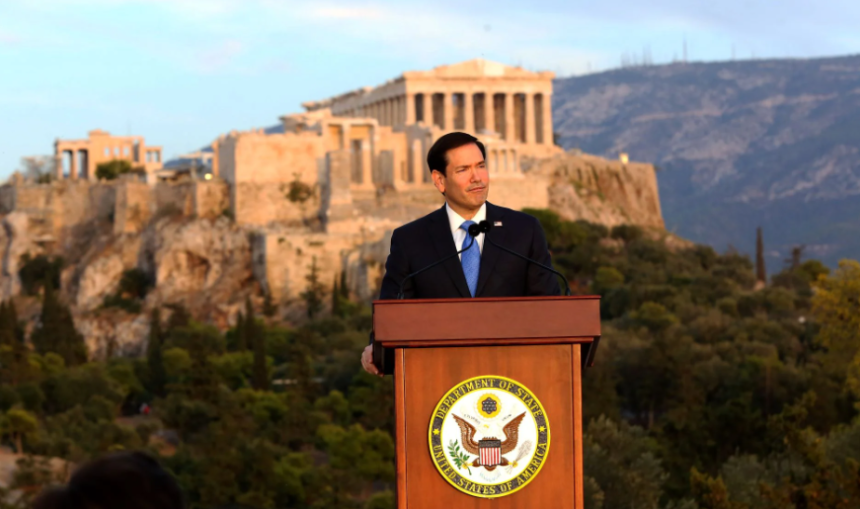
For the first time, an American Secretary of State has stated so clearly that the identity of the United States and the entire West was born in Athens. Marco Rubio said it from the Pnyx, with the Parthenon in the background, and his speech remains a hymn to Greek culture.
There are moments in diplomacy that transcend protocol. October 7, 2026 was one of them. The head of American diplomacy did not choose a conference room or the podium of a ministry to address the Greeks and the world. He climbed the hill where the ancient Athenians gathered in the Ecclesiastical City, where the citizen’s speech became, for the first time in history, a source of power.
This choice was a statement in itself. America did not come to Athens as a foreign visitor, but as a descendant returning to the ancestral home. And what followed confirmed that the symbolism was not decorative, but the essence of the message.
The anthem in Greece
Rubio opened his speech with an image that could have been written by a poet. All over the world, he said, there are great ruins, places where history seems to have run out, remnants of civilizations lost to living memory. But the Acropolis is different.
Here, in Athens, he explained, all the traits that would define the West came together for the first time in their entirety: intense individuality and indomitable ambition, the audacity of exploration and invention, the thirst for discovery, for adventure, for risk, and for glory. And above all, an insatiable curiosity about the world and the principles that govern it, a thirst to understand the mysteries of nature and the secrets of the universe.
It doesn’t just describe a glorious past. It describes the Greek way of thinking as the DNA of an entire civilization. Philosophy, science, democracy, the idea that man can understand the world with his logic, it all began here.
The American minister then drew an unbroken line from ancient Athens to modern America. The greatest Americans of each generation, he said, bear the recognizable characteristics of their ancestors: born in Athens, shaped in Rome, baptized into Christianity, hardened in the furnace of medieval Europe, endowed with the English genius for freedom, and finally transported across the Atlantic to be reborn on the shores of a new world.
The order of the words matters. The first word, the beginning of it all, is Athens. What follows, Rome, Christianity, Europe, England, are links in a chain that starts from that hill. The civilization of Athens and Rome, he added, transformed a young east coast democracy into a power of continental proportions.
This is the heart of the speech, and this is what makes it historic. Many American officials have paid tribute to Greece as the “cradle of democracy.” But no one from the position of Secretary of State had articulated so clearly and so systematically that the very identity of the United States, its character, its ambition, its soul, is Greek at its root. It was not a polite reference. It was a statement of origin.
What does it mean for Hellenism?
For Greeks, the Pnyx speech carries special weight. For decades, the country was often viewed in international capitals as a small state on the edge of Europe, with a glorious past but a limited role in the present. Rubio’s speech overturned that image. Greece was presented not as a museum, but as a living source from which the West still draws.
This recognition is not historically arbitrary. The founding fathers of the United States read Thucydides, Aristotle, and Plutarch. They discussed the democracy of ancient Athens and its weaknesses when they designed their own. Washington was filled with columns and pediments inspired by classical architecture, while dozens of American cities took on names like Athens, Sparta, Troy, and Philadelphia. Rubio gave this long tradition the voice of a modern political leader.
For the Greek diaspora in America, the speech is also a vindication. Generations of Greek Americans have built bridges between the two countries, in politics, business, the Church and academia. To hear their country’s Secretary of State say that America was spiritually born in Athens means that their dual identity is not divided, but unified.
And for Europe, the speech reminds us of something often forgotten in Brussels: that European identity does not begin with treaties and regulations, but with the values that were born in this place. Greece is the beginning of European history, not its margin.
A relationship at the highest level
The hymn to culture did not remain in the realm of ideas. Rubio’s visit sealed a Greek-American relationship that is currently at the highest point in its modern history.
The visit itself was historic. For the first time since the establishment of the Greece-US Strategic Dialogue in 2018, a sitting US Secretary of State personally led the US delegation to Athens. The 6th round of the Dialogue was not a typical technocratic meeting, but a summit.
Within a day, the two countries moved from words to deeds. A memorandum was signed for a joint security and information exchange program to combat terrorism. Agreements were signed that deepen cooperation in defense, energy and shipping. The connection of the Greek Armed Forces with the Florida National Guard was sealed, through the American State Partnership Program, for joint training, maritime security, cyber defense and natural disaster response. And the new building of the American embassy in Athens was inaugurated, a tangible symbol of long-term commitment.
Rubio called Greece an “exemplary ally,” an indispensable NATO ally and a pillar of stability in the region. The recognition has a real basis. Greece consistently maintains defense spending above the Alliance’s goal, leads naval missions in the Red Sea and Indian Ocean, and is preparing to integrate the F-35, the world’s most advanced fighter jet, into its fleet. It is a provider of security, not just a recipient of it.
In energy, Greece is emerging as a hub for all of Southeast Europe. Cooperation with the United States has reached an unprecedented level, with increasing quantities of American liquefied natural gas, American hydrocarbon exploration south of Crete, and American interest in the electrical interconnection of Greece, Cyprus, and Israel. Rubio said that Washington wants these projects to succeed and that it is fully committed to the energy partnership with Greece.
On border security, the US secretary of state described Athens as a close strategic partner, stressing that the birthplace of the West must not be threatened. This phrase ties the Pnyx hymn to the politics of the day: protecting Greece is protecting the very source of Western civilization.
The day concluded with a meeting and dinner with Prime Minister Kyriakos Mitsotakis, closing a visit that Rubio himself described as his first trip to Greece, expressing the hope that it would not be his last.
The flame that was lit here
From the Pnyx, Rubio also delivered a broader message. The West, he said, is at a turning point, faced with war, great power competition, terrorism and technological rivalry. The decisions of the next decade will write the history of the next century.
His answer was not pessimistic. He believes that Europe can awaken from its long slumber and rekindle the flame that was lit in this place millennia ago. No matter how much passions have tested the bonds between America and Europe at times, he stressed, we must not let them break. And he condensed his vision into two phrases: “We want to win together. We must win together.”
Athens’ choice of this message is key to understanding the speech. If the West is to rediscover itself, it must return to where it started. And if an example is needed of an ally that combines national pride with collective responsibility, that invests in its defense, that guards Europe’s borders and opens new energy routes, that example is Greece.
October 7, 2026 will be remembered as the day an American Secretary of State stood on the hill of democracy and recognized, with a clarity we had never heard before, that America and the West owe their souls to Greece. It was also the day that this spiritual kinship was transformed into an alliance with content, signatures, and a shared future.
Greek civilization gave the West its name, its language of thought, and its dream of freedom. From the Pnyx, America came to say thank you, and to pledge to continue this journey together with Greece.