
The Middle East is a worrying geopolitical and economic puzzle, with international energy markets reacting in a convulsive manner. On Tuesday (May 26, 2026), Brent oil prices recorded gains of more than 2% , as new US military strikes in southern Iran, combined with US President Donald Trump’s contradictory messages about the progress of negotiations, reignited a sense of uncertainty among investors.
Brent crude for July delivery rose 2.17% to $95.45 a barrel , after briefly touching the psychological $100 mark earlier in the day. In contrast, U.S. West Texas Intermediate (WTI) crude, also for July delivery, followed a completely different trajectory. It fell 4.8% to $92.04 a barrel from Friday’s close. It is worth noting that there was no settlement price for WTI on Monday, as U.S. markets were closed for Memorial Day .
The climate was ignited again after the official announcement of the US military and the US Central Command (CENTCOM). According to Washington, “self-defense strikes in southern Iran” were carried out, with the clear target of missile launch sites and boats that were allegedly laying mines in vital sea passages. The American side clarified that these operations were carried out exclusively to protect US troops from direct Iranian threats.
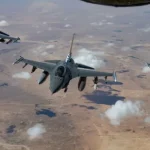
Tehran’s response was swift, raising the temperature sharply. The Islamic Revolutionary Guard Corps (IRGC) announced that it would retaliate for the ceasefire violations. In fact, it claimed that Iranian forces had detected and intercepted American drones and an F-35 fighter jet that, according to them, had violated the country’s airspace.
Despite the bellicose rhetoric on the ground, the diplomatic channel appears to remain – albeit with difficulty – open. The semi-official Iranian news agency Tasnim reported, citing an informed source, that recent talks with Washington were “overall good.” However, it set a very tough condition: the signing of any memorandum of understanding (MoU) is directly dependent on the release of $24 billion in frozen Iranian funds .
The landscape surrounding the long-awaited peace agreement has been further complicated by Donald Trump himself. In a post on social media on Monday, the US president revealed that he has openly pressured a number of powerful states in the region – Saudi Arabia, Qatar, Pakistan, Turkey, Egypt and Jordan – to join the Abraham Accords . The move, which aims to fully normalize Arab states’ relations with Israel , is a “red flag” for Tehran and adds another layer of difficulty to an already fragile negotiation that is hanging by a thread.