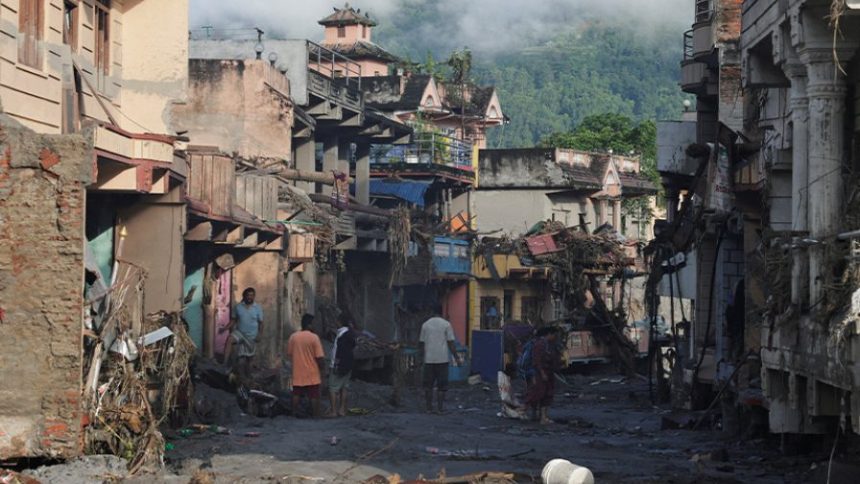
The death toll from Nepal ‘s devastating floods has risen to 675 , the country ‘s disaster management authority said on Wednesday.
Beijing has announced seven deaths , bringing the total to 683. The most worrying fact, however, is that almost 3,000 people are missing in both countries, including 2,426 on the Nepal side alone .
Rescue teams continue their efforts to locate and extricate people in the border areas, a task that is made difficult by the morphology of the terrain and the extent of the destruction.
As rescue efforts continue, the question of what lies ahead has already begun to emerge. The cost of rebuilding the areas and infrastructure could run into “many billions of dollars,” Nepal’s Foreign Minister Sisir Kanal estimated, speaking to reporters three days after the disaster.
“Reconstruction and rehabilitation could cost billions of dollars,” he said. “We will conduct a damage assessment and then we will organize. I appeal for support from the international community,” he added.
This appeal carries particular weight when one considers the state of the Nepalese economy. This is a country that was already struggling, relying heavily on tourism and, above all, remittances from Nepalese working abroad. A disaster of this scale does not just affect infrastructure, but the very mechanisms by which the economy is sustained.
Many countries and international organizations have already offered emergency financial assistance, but the amounts remain limited for now. The European Union announced 2 million euros in aid and the United Kingdom pledged 5 million pounds , or about 5.8 million euros. Against a cost described in billions, the gap is obvious.
The immediate priority, however, remains elsewhere. “For now, the priority remains to provide relief and save as many lives as possible,” the minister stressed, noting that the country has reached out to those who can offer concrete assistance.
And here comes the most difficult aspect of the case, the one that rarely makes it into the reports. “Hundreds of bodies have been discovered and there is a risk of their decomposition,” Mr. Canal said. “We also need forensic tools ,” he added, emphasizing the need to identify the victims through DNA samples .
It is an admission that illuminates the true dimension of the problem. Beyond rescuing the living and rebuilding bridges, Nepal is called upon to answer to thousands of families who exactly is missing. And for this, helicopters and funds are not enough. They need laboratories, equipment and specialized personnel that a country in this situation has difficulty providing on its own.