
There are political decisions that one can characterize as right or wrong. But there are also decisions that act as a mirror of the transformation of an entire political party .
The passage of same-sex marriage by the government of Kyriakos Mitsotakis was precisely such a moment.
When the bill was passing through the Greek Parliament, amidst strong reactions from the Church and a significant part of the traditional center-right base , the Maximos Palace was celebrating a reform that it considered emblematic.
And it’s his right.
It is the right of those who supported the reform to consider that it was an important step towards equality and rights .
But citizens also have the right to remember .
And above all, to compare words, actions, votes and political transformations .
Because the Mitsotakis government did not limit itself to a symbolic change in the name of a relationship. The reform was also linked to significant changes in family law and the parental rights of same-sex married couples .
So let’s not hide behind words.
It wasn’t just a wedding.
It was a deeper institutional and social choice , which touched on the way in which the State now perceives marriage, family and parenthood .
And that’s exactly why it caused such a big conflict.
But the interest lies elsewhere.
For a long time, attempts have been made to create the impression that this is the one-way street of modern Europe . That this is how the European Union moves, this is how the “advanced states” move, and that anyone who has a different opinion has missed the train of history.
Except that the numbers themselves spoil this convenient narrative.
Today, 16 of the 27 member states of the European Union have legalized same-sex marriage.
This means that 11 European Union countries have not adopted it .
Among them are Italy, Poland, Hungary, the Czech Republic, Croatia, Cyprus, Bulgaria, Romania, Slovakia, Latvia and Lithuania .
And there is one more element that the Greek people deserve to know.
In seven Member States , Bulgaria, Croatia, Hungary, Latvia, Lithuania, Poland and Slovakia, there are constitutional provisions that exclude marriage between persons of the same sex .
Therefore, let’s at least end the myth of the “European one-way street” .
Greece was not obligated by the European Union to legalize same-sex marriage .
It was a political choice .
It was a government choice .
It was the choice of Kyriakos Mitsotakis and the parliamentary majority that supported it .
And every political leadership must have the courage to take responsibility for its choices, instead of presenting them as an almost inevitable result of a vague “European progress.”
But what is even more impressive is the political behavior that followed .
Because many of those who voted in favor of this particular change appear today in their constituencies as guardians of tradition, family, and Orthodoxy .
And this is where the real political comedy begins.
We see them everywhere.
In services. In processions. In festivals. In patron saint’s celebrations. In the front rows of churches.
Next to the Metropolitans.
Next to the priests.
In front of the images.
And, by an amazing coincidence, almost always within a safe shooting distance of the camera lens .
Because it seems that in our days it is not enough for a politician to attend a religious ceremony.
He must be photographed as having attended .
The photo needs to be uploaded.
There should be a post about “our faith”, “our tradition”, “our values” and “our roots” .
And somewhere there the citizen has the right to ask.
What values exactly?
Because no one can or should examine the personal faith of any politician. Faith is a matter of conscience and no one has the right to decide who is and who is not a good Christian.
Political consistency , however, is a public matter.
And she is being judged.
Strictly.
When you systematically use the Church, religious holidays, and tradition as part of your public political image , you can’t be bothered because the voter remembers what you voted for in Parliament.
You can’t want the photo with the priest but not the criticism of the flock.
You can’t ask for the vote of the traditional world and then treat their value-based objections as outdated.
You cannot remember Orthodoxy when there is a festival, a litany, and a camera and consider the Church’s reaction annoying when the time comes for political decisions.
And above all, you cannot treat the Church as a convenient setting for political projection every time the ballot box approaches .
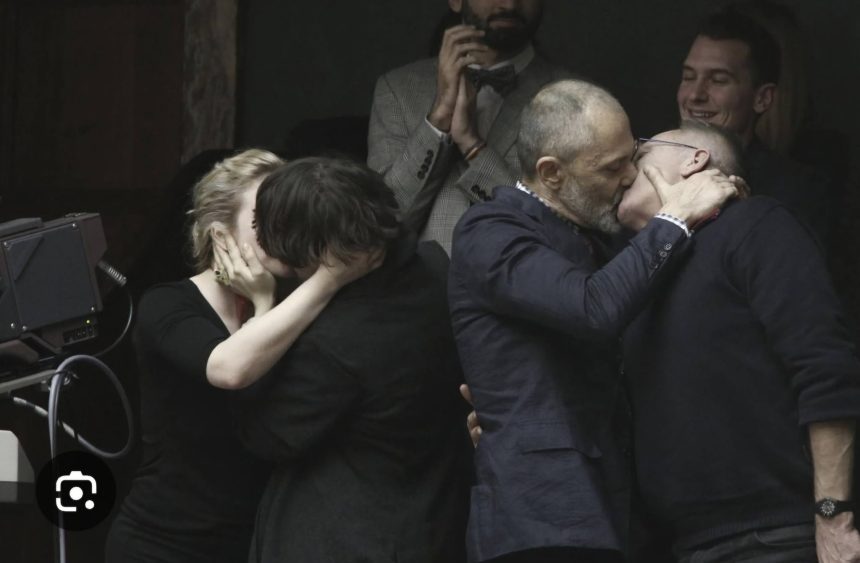
Because there is indeed an image from that parliamentary evening that is worth more than many pages of political analysis.
The halls of Parliament.
The guests.
The smiles.
The celebrations.
The feeling of a historic victory for those who supported the reform.
And no problem.
Those who truly believed in this change had every right to vote for it, support it, and celebrate it .
But then there is one simple requirement.
They should defend it with the same clarity in front of their voters.
Not two political figures .
One in Athens and another in the village.
One in Parliament and another in church.
One when the law is passed and another when the processions and summer festivals begin.
Because that is exactly the image that is created.
A policy that wants to appear progressive in Athens, traditional in the provinces, liberal in Brussels, and deeply religious in the front row of the procession .
But not everything happens at the same time.
At some point you have to explain to the voter who you really are, what you believe and most importantly what politics you represent .
And this primarily concerns today’s New Democracy.
Because the real question is not whether the party has the right to change.
Of course it has.
The question is whether he has the political courage to admit that he has changed .
That it distanced itself on critical social issues from a significant part of its traditional conservative base.
That the current New Democracy of Kyriakos Mitsotakis is not at all the New Democracy that many of its current voters knew and voted for for decades .
If this is her new political identity, let her defend it.
Net.
Without disguises.
No communication games.
Without church decor to restore relations with a traditional audience that felt ignored .
Because ultimately political choices have a cost.
And in a Democracy there is a place where this cost is measured without communication filters.
The ballot box.
There are no theories there.
There are no photographers.
There are no first places.
There are no processions for the cameras.
There are no communications staffs that can correct the image.
There is only the citizen, his memory and his vote .
And then it will be seen whether the traditional base of New Democracy considers that the party has evolved or whether it believes that it has mutated into something that it now finds difficult to recognize .
So, a little patience.
The elections will come.
And then it will prove to be something that no communication strategy can change.
The ballot box has a much better memory than the Maximos Palace.
MAXIMOS TH. KYPRIANOU