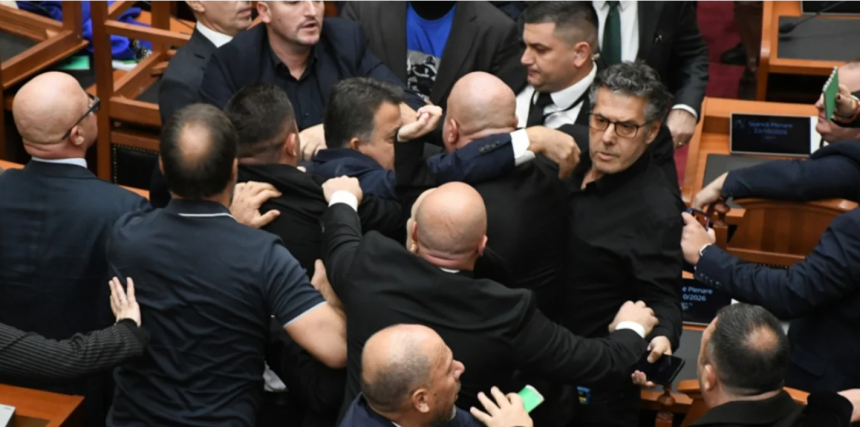
The Albanian Parliament became a scene of intense confrontation and clashes on Thursday, October 22 , with opposition MPs blocking the stage, overturning chairs and clashing with members of the government majority.
The session began in a climate of political tension, as the protests that have been going on for ten days have been the central point of reference for the opposition. The planned discussions were set aside and the majority proceeded to votes, concluding the proceedings after about an hour.
The confrontation broke out almost immediately after the plenary session began. While the Speaker of the House, Nikos Pelesi , was presenting the agenda, MPs from the opposition Democratic Party gathered in front of the podium and blocked access. With this move, they attempted to disrupt the normal course of the session, linking their protest to what was happening on the streets and demanding a political response to the crisis.
At the center of the incidents was MP Flamur Noka , who approached the head of the parliamentary group of the ruling Socialist Party, Taulant Bala , took away his microphone and threw documents at him. According to Albanian media reports, the clash broke out while Bala was defending the police’s stance on the protests. The incident led to the temporary suspension of the session by the speaker of the Parliament.
Tensions, however, continued. Opposition MPs pounded on benches, overturned chairs and attempted to remove voting cards from their majority colleagues. These actions sparked new confrontations inside the chamber as the government side tried to continue the process. The removal of the cards became another point of conflict, with the obstruction of votes added to the blockade of the stage.
Incidents were also recorded near the headquarters of Nikos Pelesi , who was thrown water. Opposition MPs chanted “Parliament of crime” and held photos of injured protesters, conveying their complaints about the management of the demonstrations to the chamber. The slogan expressed the opposition’s political attack on the majority, while the photos were used to highlight the issue of injuries.
The opposition argued that developments in the demonstrations should take precedence over the usual parliamentary agenda. In a statement carried by Albanian media, the Democratic Party parliamentary group expressed support for the protesters’ demands and condemned what it called police violence . The government side, on the other hand, defended the police’s performance of their duties. The disagreement over the management of the demonstrations thus became a direct cause for the escalation in the plenary.
The agenda included, among other things, a proposal to establish a special parliamentary committee for the second phase of the administrative and territorial reform . This specific item concerned the preparation of the next phase of the process and not, according to the published agenda, the final adoption of a comprehensive new administrative map. Parliamentary questions to ministers and the examination of a series of bills were also scheduled.
Under pressure from the incidents, the majority bypassed the scheduled debates and proceeded to a quick vote on the bills on the agenda . The proceedings continued amidst protests and arguments until the end of the session. The process was closed without a condition of substantive parliamentary dialogue having been restored.
Meanwhile, students and young protesters were outside the parliament building , continuing their protests against the government of Edi Rama . According to local reports, their demands included the resignation of the prime minister. Their presence outside the building and the confrontation between the MPs inside were two parallel expressions of the same political tension.
The session highlighted the depth of the conflict between the government and the opposition. The obstruction of the stage, physical confrontations and attempts to remove voting cards limited the possibility of the plenary session functioning normally. The majority’s choice to complete the votes brought the session to a procedural end, but left open the political confrontation over the demonstrations, the police attitude and the way parliament functions.