History sometimes has a strange way of turning a blind eye to us.
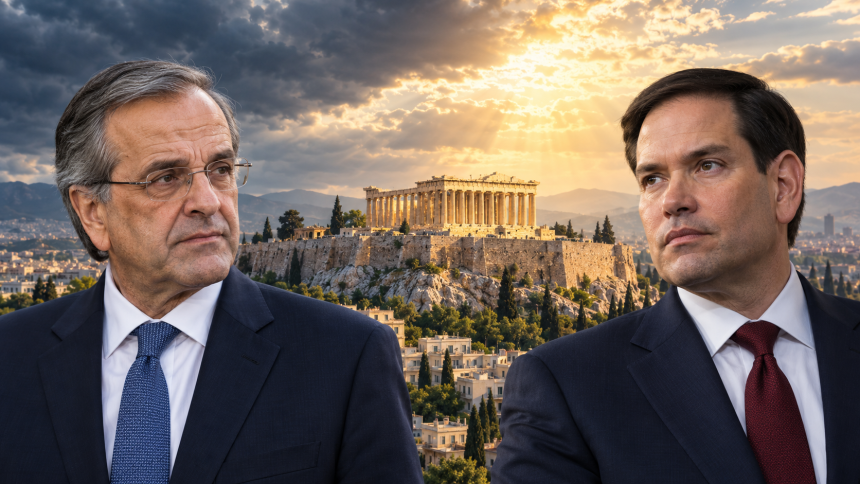
— On October 6 , Antonis Samaras spoke at the “Vima” event on Athens , Culture and Politics .
He also spoke about Decline . About its signs. About the society that is gradually losing touch with Education , History , collectivity , models , vision …
— A day later, on October 7 , US Secretary of State Marco Rubio spoke in Athens . In front of the Acropolis .
And he also spoke about the Decline of the West .
Not for Greek society. For the entire West .
And yet, the two speeches had much more in common – and some differences of course…
* Rubio used an ancient Greek word: thumos .
Passion . Ambition . The desire to create , to distinguish , to transcend . The inner strength that makes a person — and a people — want to create something greater than themselves .
And he contrasted this spirit with a contemporary West that, as he argued, has begun to lower its demands .
To dig down instead of build up .
To fear excellence , because it creates inequalities.
To consider national ambition “suspicious”.
To feel guilty about her story .
Accept the loss of productive and technological power as an almost “normal development”.
And finally forget something very simple:
that no civilization survives forever on the achievements of previous generations .
* Samaras used different words.
He spoke of materialism and individualism . Of spiritual desolation . Of the decline of collective values . Of the weakening of Education . Of the absence of standards . Of the society that limits its ambitions and settles for (temporary) ease.
But logic is relative.
One speaks of the loss of thumos – the aspiration for distinction.
The other is about the loss of vision , without which there is no ambition and no passion for distinction.
One says that the West forgot to build upwards .
The other is that society has forgotten to demand more of itself than what seems ephemerally convenient.
* And there is something even more interesting.
Rubio talked about decline, in terms of power . And by way of decline, loss of power .
In Industry . Energy . Defense . Technology . Borders . National sovereignty . Productive base .
His own concern is that a Civilization that loses its material power ultimately loses its ability to defend its values .
Samaras spoke about the decline on the part of society and political leadership .
What kind of people are we becoming?
What standards do we have?
What are our children learning?
What kind of society are we creating?
And, most importantly, what responsibility does the political leadership have when they see the signs?
There is a fundamental difference here.
Rubio asks:
— How will the West become strong again?
Samaras asks:
— How will society regain the inner strength to not compromise with decline?
One looks more outward.
The other one more inward.
But somewhere in the middle they meet.
Because without inner strength there is no outer power .
And without external power , a Civilization’s internal self-confidence does not last long.
And then comes Athens .
Not just any Athens.
The Athens of the Acropolis .
Rubio did not choose the place to talk about the West by chance.
He spoke in front of the Parthenon about a Civilization that, two and a half thousand years ago, was not afraid to build something that went beyond its immediate needs .
— They did not build the Parthenon to ensure the “management of everyday life” .
— They did not create the Theater for simple “entertainment”. But to train their citizens in the moral dilemmas and responsibility of power that Democracy requires…
— They did not establish Philosophical reflection to solve current “biotic problems”. But to solve existential problems of human Freedom – that is, of the organized City that is not simply a sum of people, but a society of free citizens-persons .
And Freedom without spiritual content does not survive …
They didn’t always succeed…
But they built something that could last forever!
This is the thumos that Rubio is invoking.
— And here the coincidence with Samaras’ speech takes on an almost symbolic dimension .
Because Samaras spoke a day earlier about the need to return to the politics of ideas and visions .
Rubio, a day later, in front of the Parthenon, said much the same thing, in the language of American strategy :
You cannot defend a Culture if you don’t believe it is worth defending.
And he slandered a modern trend in the West that is ashamed of itself . And therefore, it cannot defend anything…
Both spoke to the place that gave birth to Freedom as Reflection, as Aesthetics and as Ethos .
Both spoke of the Decline of the West , which lost touch with both Freedom – with its History and with its current people …
* However, there is a difference that is worth noting.
Rubio spoke as US Secretary of State . His own response to decline is ultimately the reconstruction of power .
Samaras spoke as a Greek politician who has traveled an entire political path. And here he introduces something that Rubio does not put at the center of his own speech: the personal responsibility of political leadership .
It is not enough to identify the decline .
And of course, it’s not enough to just manage it .
Someone must take responsibility to turn it around .
This is perhaps the most purely “Samaritan” element of the speech.
Politics , he essentially says, is not a profession of managing the present. It is not nostalgia – nor imitation – of the “glorious” past.
It is a responsibility towards the future .
And here he meets, in another way, with Rubio.
Because he also says that the decisions of the next decade will write the history of the next century .
Politics , in other words, becomes History again .
No management…
History! That has not yet been written. But that challenges those of today, on behalf of those who come …
Rubio says, let’s find ourselves again , let’s find our pride again , let’s become strong again .
Samaras says to rediscover our spirituality , our visions and values, from which our strength stems.
* And then came the… cable .
Because there is also the other side of decline .
The theory, of course, is attractive.
But at some point reality sets in.
And the reality, this time, was a cable on the seabed of the Eastern Mediterranean .
Rubio was asked about the Greece-Cyprus power cable and Turkey’s reaction . He did not publicly take a position in favor of the Greek position . Nor could he, of course. He spoke of “delicate issues” that also concern third countries and which are better dealt with diplomatically, privately .
Marco Rubio is the United States Secretary of State.
They ask him how Greece should react towards Turkey , while at the same time Greece proclaims its… “friendship” with Turkey (which threatens it!)
— Find them with your friends , he basically told us…
American diplomacy has its own interests , its own balances , its own priorities .
And Greek diplomacy is paying for its own mistakes …
When you declare your friendship with your enemy , don’t expect others to treat you differently…
So let’s do a little historical experiment .
Let’s suppose that, before the “Medes” , when the Persian army approached Greek territory, someone went to the Greeks and said to them:
— ” Find a way with the Persians . You have differences, of course. But don’t let them ruin the understanding. Peace and stability are above all.”
What would have happened?
Or let’s go to 1821 .
The Greeks are preparing to rise up against the Ottoman Empire . Someone appears and tells them:
— ” Get over it with the Ottomans . You have a long history of coexistence. There are problems, but dialogue is needed. Don’t cause tensions.”
What would have happened?
Or, even more specifically (to leave the Greek space), let’s move to 1683 .
Vienna is surrounded by the Ottomans . Europe is facing a crucial confrontation . And someone goes to the besieged and says:
— ” Find them with your besiegers .”
Would the West , as we know it today, exist?
Would the Civilization exist that, a day before, Rubio himself spoke about with such passion?
Would Europe as we know it, of which we are — and rightly — proud, exist?
* Free men and free peoples did not become free because they always found a “compromise” with those who threatened them.
They became free because, at some critical moments, they refused to accept that their Freedom was a matter of negotiation .
And somewhere here the discussion about decline ceases to be theoretical .
It’s not somewhere else.
It’s not just in Europe that it’s getting older .
It’s not just in the West that production is losing ground .
It’s not just in America that people are wondering about its power .
It is around us .
Sometimes it is within us .
It is the moment when we call retreat “realism” .
The moment when we call immobility “stability” .
The moment when we call “dialogue” the acceptance of faits accomplis .
That’s exactly where the decline begins.
* Rubio came to Greece to speak about the Decline of the West .
For deindustrialization ,
for the weakening of borders and national sovereignty ,
about “identity conflicts” and the woke agenda ,
for the decline and deconstruction of all Western civilization .
He is not a marginal person, someone “sprayed”. He is the foreign minister of the western superpower .
And US Vice President JD Vance has said something similar in the last year…
So there is a West that is already resisting its Decline .
And Samaras , who has been positioned for all of this for years in Greece, often alone – now he is no longer alone .
It expresses something that is gaining ground in the West .
But he speaks of the need to resist Decline within Greece .
And he summed it up in a single sentence.
Don’t Negotiate Your Dignity!
Because without Dignity there is no Freedom .
And without Freedom , there would be no West , which today we fear may decline.
*That’s why the Decline that everyone now recognizes is not found anywhere else.
It is around us .
And, sometimes, within us .
This is why the appeal becomes even more urgent :
Let’s resist Decline.