
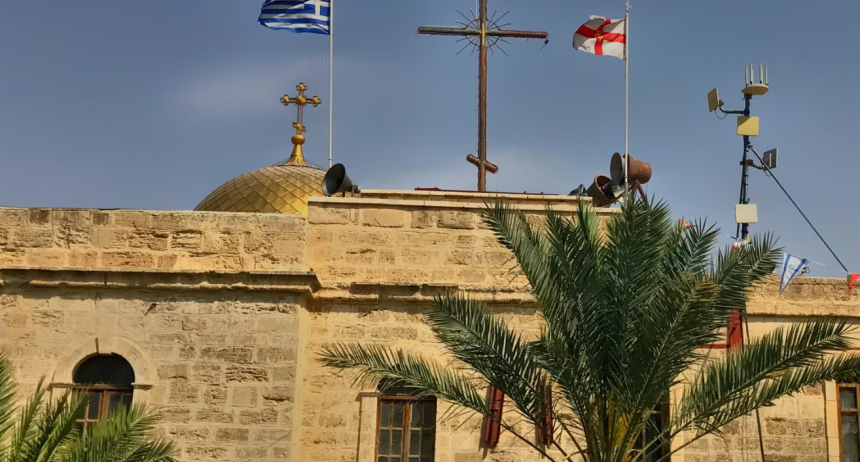
It took fifty years to build the balances. A few days are enough to put them into question. The death of the blessed abbot of the Holy Monastery of Saint Gerasimos of Jordan opened the bag of Aeolus, bringing turmoil and concern for the monastery that he himself resurrected and served for more than fifty years.
The tension concerns the continued operation of the Monastery, which is located on the outskirts of the Palestinian city of Jericho , in the West Bank . Cypriot believers and pilgrims are expressing their concern over the decision of the Patriarchate of Jerusalem to evacuate the monastery of its monks and the Arab residents of Jericho who are employed there in manual and agricultural work.
A few days before the abbot’s departure, the Patriarchate appointed a three-member committee to manage the transitional period until the Holy Synod convened and appointed a new abbot. Immediately afterwards, the monks were asked to temporarily relocate and entry was prohibited to those working at the Monastery, so that an inventory of its property could be made possible.
The census is an established practice when a new abbot is to be appointed to a monastery. In this particular case, however, there is a special condition, as the work of the blessed Abbot Chrysostomos was great and multidimensional. With self-sacrifice, diplomacy and perseverance, he guarded the pilgrimage as a genuine Hagiotaphite, guarded the land of the Patriarchate and saved the lands of the Monastery from territorial claims and illegalities. There are, moreover, testimonies and interviews of him in which he himself speaks about all of this.
At the same time, he managed to help many poor families in the area and support the other monasteries of the Holy Land, turning the pilgrimage, in the middle of the desert, into one of the most important attractions for pilgrims , not only from Israel but also from Greece, Cyprus and other countries with a strong Orthodox flock.
The sealing of the Monastery was deemed necessary to prevent theft or removal of important documents, even relics of the blessed Elder. These days, the pilgrimage remains accessible to the faithful during certain hours of the day, while elderly women who lack other shelter continue to reside in its premises. The transitional period, as noted, is not going to last long and will end with the election of the new abbot.
To rumors that the Monastery is about to close , the Patriarchate of Jerusalem responds categorically that its role is to maintain its pilgrimage sites and monasteries and to encourage pilgrims everywhere to exercise their religious rights and duties. Its goal is to make the process of handing over and receiving the new abbot as smooth as possible.
The most critical issue, however, concerns the lands . The Patriarchate seeks to find the Monastery the next day with its property measured and the dispute resolved regarding the extent of the lands it owns, in relation to the presence of the neighboring Jewish settlement of Bet Hogla . This is a dispute that has not yet been resolved by a local judicial body.
Here lies the crux of the whole affair. The geographical location of the Monastery is of particular importance. It is located between the outskirts of Jericho, which is administratively under the Palestinian Authority , and Area C of the West Bank, which, as defined by the Oslo Accords , is under Israeli military administration.
The late Abbot Chrysostomos had succeeded in creating and maintaining delicate balances between the two sides. He achieved, among other things, the provision of electricity from the Israeli side, while at the same time securing Israeli consent for Arab residents of Jericho to receive special permits to reside and work in the monastery area. The Patriarchate’s concern, according to well-informed sources, is precisely to maintain these beneficial balances.
As for the future, the new abbot, who will be chosen by the Holy Synod, will be responsible for choosing the monks who will support him in his work. The blessed abbot had exactly the same opportunity when he took over the operation of the Monastery and throughout the decades that followed. The same applies to the physiognomy of the Monastery, as well as to the conditions and terms of employment of the Arab residents of Jericho.
Source: www.orthodoxianewsagency.gr