
There are moments that call for silence . Not because some external rule demands it, but because human sensitivity itself dictates it. One such moment is the entry of a coffin into the Church . The time of the final farewell .
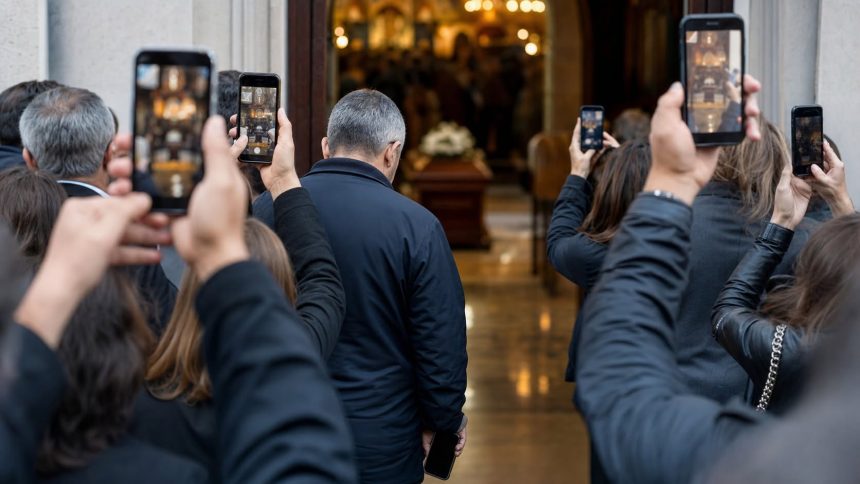
On the occasion of the funeral of George Mazonakis , on Monday, September 14, 2026 , at the Holy Trinity Church in Nicaea , a concern arose that does not only concern this specific incident. The funeral had been announced for Monday, while the singer’s death had been announced a few days earlier. In images that were heavily commented on, several people raised their mobile phones to photograph or videotape the entrance of the coffin into the Church.
The reaction of many was negative . And not without reason. The question is whether we still have the ability to distinguish which moments we should live and which ones we should record . If there are boundaries between memory and spectacle . If emotion always needs a screen to be considered real .
The mobile phone has become almost a natural extension of our hand . We see something beautiful, strange, moving or tragic and our first move is often to record it. We don’t have time to stand in the moment . We don’t have time to be silent . The camera opens before the crisis takes effect . Events that require delicacy and respect are turned into material to post on social media .
Of course, recording is not problematic in itself. People have always wanted to keep memories . A photograph can be an act of love , memory , participation . Especially in the case of a public figure , an artist who was connected to the lives of many people, mourning is not limited to the family . It also touches the audience who loved him through his songs, performances, and personal moments.
Some will say that those who picked up the phone wanted to capture one last snapshot . Others that they wanted to share it with people who couldn’t be there. Some may not have acted out of indiscretion , but out of embarrassment , emotion , or habit .
But memory is one thing, and consuming the moment is another. It’s one thing to participate in mourning and another to treat the entrance of a coffin into the Church as a public spectacle . That’s exactly where the problem lies.
For the Church , a funeral is not simply a social farewell ceremony . It is a sacred service . It is the Church’s prayer for the repose of the deceased . Man is created in the image of God . This truth is not lost with death. That is why the body of the deceased is not treated as a simple biological residue , but is honored with prayer , reverence and dignity . The Church stands before the dead person with seriousness , not with curiosity . With prayer , not with spectacle . With hope and expectation of the Resurrection , not with worldly noise .
Even the phrase “ eternal memory ” reveals that memory , in the ecclesial experience , is not a file on a mobile phone or a video that will be lost in the flow of social networks . It is the request that man rest in the mercy of God and remain alive in the love of those who remember him. True memory does not always need an image . It often needs a heart .
This does not mean that we should demonize technology . The mobile phone can become a tool for communication , comfort , information , and even support . It can bring people together who are far apart. It can preserve moments that have value. The problem is not the device . The problem is the lack of moderation .
Technology has given us the ability to record almost everything . But it has not taught us by itself what not to record . This is a matter of education , ethics , and inner cultivation . It is not enough to know how the camera works . We must also know when to turn it off .
That is where today’s man is tested . Not in whether he can use technology, but in whether he can use it with discernment . In whether he can understand that the sorrow of a family , the sanctity of a procession , the silence in the face of death , are not content to be distributed .
We live in an era that pushes us to constantly prove that we were somewhere. That we saw, lived, were moved. But respect does not need online proof . The truest presence can be silent . To stand at a funeral without taking pictures . To let the family mourn without feeling surrounded by lenses . To look with your own eyes and not through the screen .
Ultimately, the question is not whether we are allowed to use mobile phones. The question is whether we know when not to . Whether we can distinguish the public from the sacred , participation from indiscriminate , memory from spectacle .
NEKTARIOS TSILIS, Metropolitan of Hong Kong and Southeast Asia