

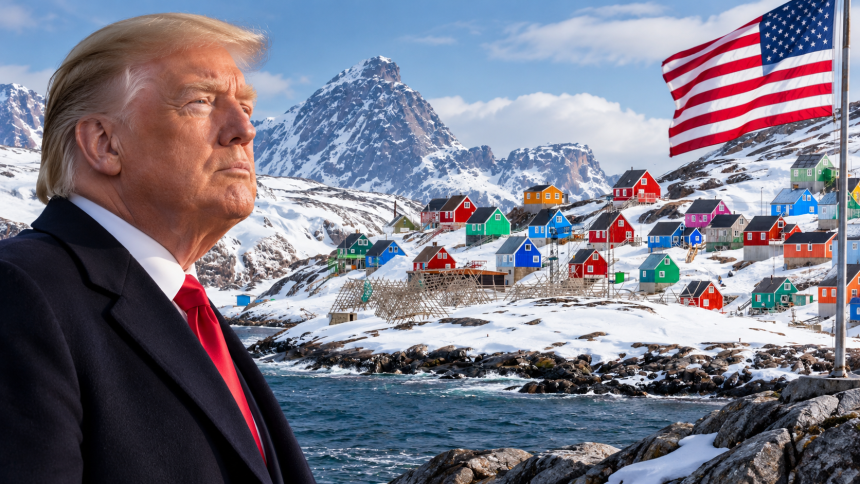
An island of 57,000 people has suddenly found itself at the center of the global geopolitical chessboard. The agreement between the US and Denmark over Greenland opens a new era in the balances in the Arctic and the North Atlantic .
US President Donald Trump announced that Washington had reached an agreement that would give it “permanent security control” over the island. In a post on the Truth Social platform, he said that the US would have “full ability to do whatever is necessary in Greenland” to ensure the security of both the island and itself. He also added that a significant military presence is expected to be deployed there soon, without giving further details.
The content of the agreement, as described by a State Department official to Reuters, is particularly revealing. It prohibits non- NATO countries from building a military base in Greenland. At the same time, only the United States and its allies will be able to make “sensitive investments” on the island, without specifying what exactly that term includes.
According to the same source, the US will gain permanent access , as well as force deployment and overflight rights. The most critical point, however, lies elsewhere. These terms will continue to apply even if Greenland gains independence , a commitment that goes beyond the island’s statehood itself.
However, several questions remain unanswered, including whether the agreement will lead to the construction of new US bases. Imran Bayoumi , a former Pentagon official and current member of the Atlantic Council, was critical, stating that Washington “could have achieved many of these goals through diplomacy and dialogue, without burdening the broader US-NATO relationship.” In order to be implemented, the agreement will also require parliamentary procedures in both Denmark and Greenland.
Danish Prime Minister Mette Frederiksen confirmed the agreement on Friday night, noting that it was expected to be signed next week. She said there was “the prospect of a good agreement for Greenland, the Kingdom of Denmark and the United States,” describing the development as “strengthening our common security in the Arctic and the North Atlantic region.”
For his part, Greenlandic Prime Minister Jens-Frederik Nielsen said the agreement would “ensure and strengthen” the security of Greenland, Denmark, the US and the Western alliance, describing it as “to the benefit of us all.”
The island’s strategic importance is not a recent discovery. Greenland, a semi-autonomous Danish territory northeast of Canada, offers a geopolitical advantage that the United States has sought for more than 150 years . Trump has repeatedly expressed his intention to acquire it, even hinting in the past at the possibility of military action, arguing that the island is “very important to the national security of the United States, Europe and other parts of the free world.”
The data supporting this assessment is specific. The shortest distance between Russia and the United States passes over Greenland , which makes the island a key point for the anti-ballistic defense system. There is already a large American military installation, the Pituffik Space Base .
Added to this is a parameter that is rapidly changing the map. As Sky News military analyst Sean Bell has pointed out, global warming is melting ice and opening up new trade routes that previously remained inaccessible for much of the year. This creates new and more economical routes for transporting goods from Europe to Japan, around Greenland.
On the defense side, according to Sky News’ US correspondent James Matthews , the discussions concern, among other things, the use of the island as part of the “Golden Dome” , the defense system that will protect against missile attacks in the Arctic, including threats from China and Russia .
Experts, however, have questioned the claims of an immediate threat from Russian and Chinese ships around Greenland. And here arises the most fundamental question of the case. If the threat is not so immediate, then the agreement does not respond to a current danger but anticipates a future in which the Arctic will have been transformed into a floating trade corridor and a field of competition between great powers.