

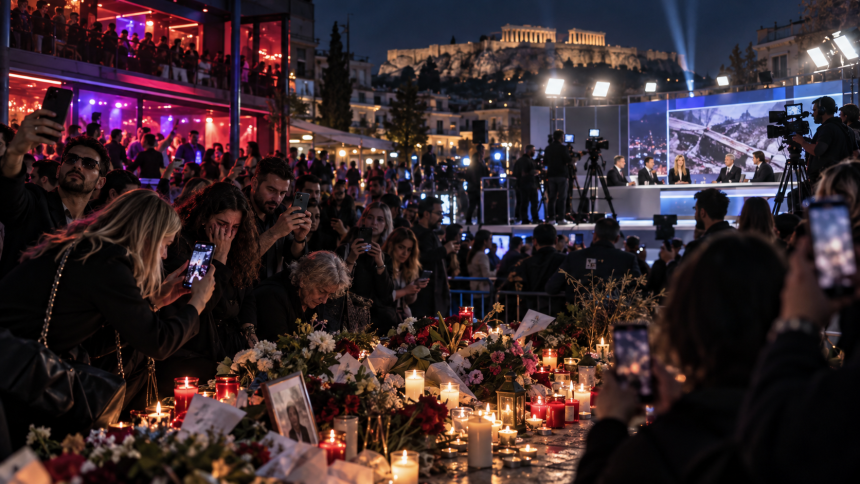
Greece does not suffer from a lack of emotion . It suffers from a lack of consistency . It does not lack anger. It lacks duration . It does not lack complaints. It lacks institutional demand . It does not lack tears. It lacks the decision to truly change what hurts it.
Because the question is not just what happened to Mazonakis. The question is why in this country a person must first be lost for us to remember that there are institutions that must function. Why there must be a dead person for us to discuss controls , rules , responsibilities and accountability . Why the self-evident functioning of an organized state becomes an issue only when its failure acquires a face , a name and a television image .
Here lies the great Greek disease . We do not prevent. We react. We do not control. We denounce after the celebration. We do not build institutions. We set up discussions. We do not assign responsibilities seriously. We set up public ceremonies of indignation.
And then we wonder why nothing changes .
Nothing changes because we stopped asking for change . We ask for relief . We ask for someone to pay symbolically. We ask for a person to burden the entire burden of collective failure on. We ask for a story that fits easily on television. A good one. A bad one. An innocent one. A guilty one. An expert. A presenter. A tear. An applause. A commercial break.
But real life is not a show. And justice is not served by television footage. Nor are institutions replaced by angry commentators and sensitive moment-honorers.
Television did not create this decline on its own. It found it ready and made a profession of it. It took a society that was tired , angry , confused and afraid , and offered it the easiest drug. Spectacle . Emotion without responsibility . Rage without cost . Participation without action . Purification without change .
And the viewer got comfortable. Because it’s easier to be indignant from the couch than to persistently demand as a citizen. It’s easier to write a comment than to watch who’s to blame, who resigns, who’s punished, and what changes. It’s easier to cry in front of the screen than to stare into the eyes of the country you’re used to.
This habit is the most dangerous. Not poverty alone. Not punctuality alone. Not political incompetence alone. The most dangerous thing is that all of this has become almost normal . The worker is pressured and we say this is life . Rent suffocates the household and we say we will somehow manage . Punctuality destroys the salary and we say it will pass . Political power communicates instead of works and we say we are all the same .
And this everyone is the same is the most convenient alibi for decline. If everyone is the same, then no one is specifically to blame. If no one is specifically to blame, no one is held accountable. If no one is held accountable, everything continues. And if everything continues, then decline is not an accident. It is a system .
Within this system, the night is not just a place for entertainment. It is a symbol . It is not the fault of folk songs. It is not the fault of bouzoukis. It is not the fault of man’s need to forget himself. It is the fault that an entire society began to live with the logic of the dance floor . A lot of noise, little thought. A lot of lights, low consciousness. A lot of show, little substance. A lot of emotion, zero memory.
Entertainment became a substitute for meaning. Image replaced reality. Momentary emotion replaced responsibility. And social life became filled with people protesting corruption on their cell phones and a moment later taking pictures of themselves smiling at the next table, as if nothing was happening around them.
This is not moralizing. It is a political diagnosis . A society that cannot distinguish the serious from the noisy , the essential from the impressive , mourning from display , responsibility from spectacle , is a society that is losing itself.
And when a society loses itself, it doesn’t always have to collapse with a bang. It can rot quietly . It can laugh, sing, post, get angry, cry, forget and move on. It can have full stores and empty stares . It can have thousands of posts and no collective memory. It can have daily outrage and no real resistance.
This is today’s Greece at its most disturbing. A country that is not devoid of emotion, but lacking in direction . A country that is not devoid of voices, but lacking in serious public thought . A country that is not devoid of anger, but lacking in political consistency . A country that can both truly mourn and simultaneously turn its mourning into material for consumption .
Mazonakis, as a public figure, was associated with an entire era of modern Greek entertainment . This is neither an accusation nor a hagiography. It is an observation. The public reaction to his loss revealed how deeply the need to live through faces , symbols , scenes and images has penetrated this country. To cry publicly, to get angry publicly, to condemn publicly, but to systematically avoid the most difficult act. To change privately and collectively .
And here is the point. A country will not be saved because it was moved . It will only be saved if its movement becomes memory , memory becomes a demand , and the demand becomes institutional change . Otherwise, every death will become front page news for a few hours, every tragedy will become a television marathon, every scandal will become panel material, and we will end up at the same point every time.
In the same anger . In the same words . In the same promises . In the same oblivion .
Greece is not only at risk from those who govern it badly. It is not only at risk from those who exploit it. It is not only at risk from those who profit from the weakness of institutions. It is mainly at risk from its ability to get used to everything.
To get used to accuracy . To get used to arbitrariness . To get used to fraud . To get used to inadequacy . To get used to impunity . To even get used to death as a television unit .
If there is anything we should take from this case, it is not another moment of collective mourning. It is the need to stop functioning as a public and become a society again. To stop waiting for the next dead person to discover the next institutional vacuum. To stop assigning the role of justice to the public and the role of conscience to television.
Because a society that remembers only as long as the news lasts has no memory . It has reflexes. A society that only gets angry in front of the camera has no political consciousness . It has television anger. And a society that turns every tragedy into a spectacle will sooner or later discover that it has not only lost respect for its dead.
She also lost respect for herself .
MAXIMOS TH. KYPRIANOU