

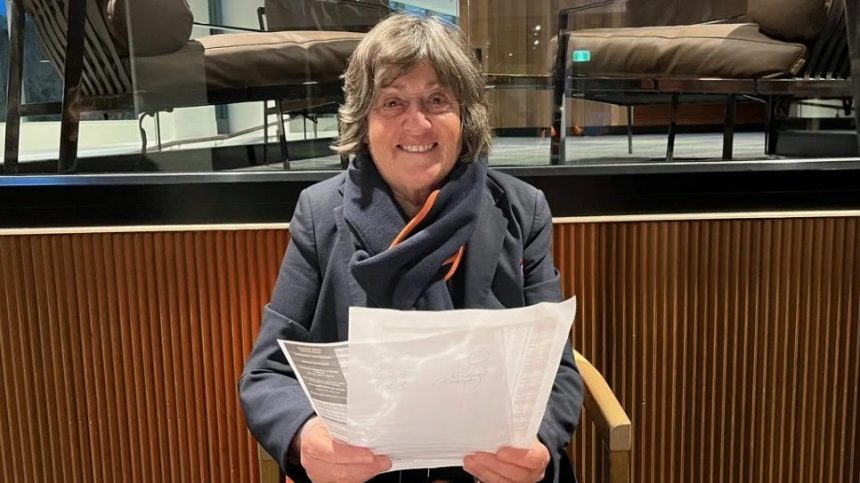
Melbourne. Communities rarely honour those who work quietly. But this year, the top honour of the Victorian Kastellorizoans went to just such a case: historian and archivist Florence Livery was named Kastellorizoan of the Year 2026, for her contribution to the community — a contribution measured not in events and speeches, but in boxes of documents, photographs and names that were in danger of being lost.
From the classroom to the archive
Her journey is typical of an entire generation of Greek Australians who have dedicated their “second lives” to the community. She taught in secondary education for thirty-five years. When she retired in 2011, she turned to what had always been her personal passion: researching and documenting the history of the first Kastellorizo people who settled in Australia.
She has since taken on the role of archivist and historian for the Kastellorizo Association of Victoria (KAV), with her current research focusing on the Kastellorizos who arrived in Melbourne around the years of World War I — the darkest, documentary-wise, period of colonial history, where traces are few and scattered.
The archival collection she manages is not limited to papers. It includes manuscripts, letters, photographs, audiovisual material, works of art, books, diaries and objects, along with their digital copies. At the same time, she volunteers her services on a weekly basis at the Archives Centre of the Greek Community of Melbourne, collaborating with historian Georgia Harpantidou in the restoration and classification of archives that had remained in storage for years.
The unwritten history of women
One of the most recognizable pieces of her work concerns the women of the community. As part of the Greek History and Culture Seminars of the Greek Community of Melbourne, Livery presented her study entitled “Stardust: The Golden Years of the Castellorizian Ladies Society, Melbourne (1961–1978)”, dedicated to one of the first independent women’s clubs within the Greek community of Melbourne.
Her interest there was not simply celebratory. The presentation focused on the struggle of those women to be heard and taken seriously — not only by their own community, but also by the wider Greek community and the Melbourne establishment. A story, in other words, that had not yet found its place in the official narrative.
An institution with thirty years of history
The title of “Kastellorizi of the Year” has been awarded by the Kastellorizi Association of Victoria since 1993 to a member of the community who has made a significant contribution. Past honorees include figures such as businessman Andrew Liveris and Lilliane Gomatos AM.
This year’s award comes on the heels of a landmark year for the Kastellorizos of Victoria. The Association, founded in 1925 to support immigrants from the small island of Kastellorizo, celebrated a century of existence in 2025, with events that included an exhibition of heirlooms, costumes and jewellery at the Kazzie Club in South Melbourne and an anniversary trip for members to Greece, with stops in Athens, the Peloponnese, Rhodes, Symi and, of course, Kastellorizo.
The Kastellorizo people arrived in Australia in four successive waves: at the end of the 19th century, from 1921 to 1926, from 1927 to 1939, and finally after 1945 — after the great fire that devastated the island. The documentation of precisely these routes is the subject of the work honored this year.
Why it matters
At a time when the Greek community in Australia is anxiously discussing the transition to the third, fourth and fifth generation, awarding an archivist is not a decorative choice. Archives are the prerequisite of memory: without them, the history of a community ceases to be a documented narrative and becomes a collection of family legends, which diminish with each funeral.
The recognition of Florence Livery is, in this sense, a statement of priorities by the community itself: that someone must tell its story — and that someone, for the past fifteen years, has been doing so.