

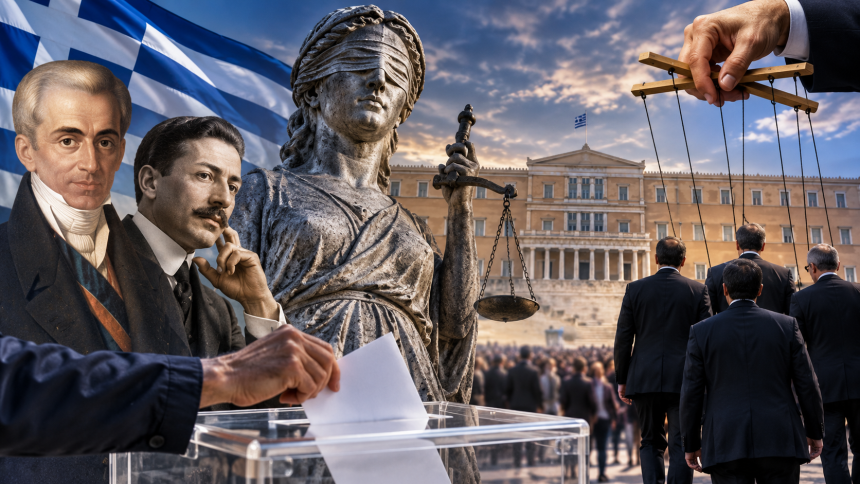
The Greek Left has a term it uses with pride. It calls it democratic centralism . The theory is simple. You discuss freely, you vote, and then everyone carries out what the higher body decided. The discussion closes. The minority is silent. Unity precedes truth.
The funny thing, and the tragic thing, is that this term today describes the entire Greek political system. Not one party. Everything.
Look at how our democracy works in practice. The leader decides. The press office formulates. The deputies vote. Anyone who disagrees loses his place on the ballot. The citizen is called upon once every four years to ratify the choice between two or three closed mechanisms that have already decided everything without him. This is not popular sovereignty. It is democratic centralism with better branding.
And because it has the word democracy in its name, you are not allowed to question it. Once you do, you are accused of attacking freedom. It is the most perfect safety net ever invented. The system is protected from criticism by using the name of what it has ceased to be.
Let’s get something straight. Voting legitimizes. It doesn’t certify. It’s a process of selection, not proof of quality.
Plato pointed it out twenty-four centuries ago and since then we have been repeating it in the auditoriums without applying it anywhere. We do not trust a vote to choose a surgeon, a pilot or a bridge engineer.
For the governance of a state with eleven million people, we believe that popularity is sufficient.
The problem is not that people vote. The problem is that we give them a choice between products designed by the same teams, with the same polling tools, to sell to the same audience. The modern politician no longer tries to convince the citizen of the right thing. He measures what the citizen wants to hear and serves it to him. The difference between politics and advertising has disappeared, and the only group that has not understood this is those who still talk about ideologies.
Tell me what a popular mandate means when every serious reform takes ten years to pay off and every government plans for eighteen months. The system systematically punishes whoever does the right thing and rewards whoever does the easy thing. This is not an accident. It is the way it works.
And here’s where the story comes to spoil our mood.
Ioannis Kapodistrias took over a country that was not a country. Ruins, piracy, armed factions, zero administration, civil hatred still hot. In January 1828, the Parliament itself suspended itself and the Constitution of Troizina, the Panhellenic Assembly was created as an advisory body and executive power was concentrated in the hands of one man. By today’s standards, a coup d’état with parliamentary approval.
He built an administration, an army, schools, courts. He did not get rich. He did not create a dynasty. He was assassinated in Nafplio. Whatever one believes about his methods, the question he left behind remains unanswered and disturbing. Can there be democracy before there is a state? Kapodistrias answered no. Two centuries later, with state mechanisms that cannot execute their own decisions, I am not sure that we have earned the right to criticize him from above.
Ion Dragoumis came from a completely different starting point and reached a related conclusion. He came out vehemently against partisanship and imported institutional imitativity. He was not an enemy of parliamentarism, and anyone who presents him that way is reading him carelessly. In his texts he proposes an elected Parliament. This makes him more useful, not less. He did not denounce elections. He denounced the transformation of elections into an end in itself and politics into a profession.
Now the hard part, because it would be cheap to stop here and imply that we need a strong man.
We don’t need it. Enlightened leadership has a flaw that no theory has ever cured. There is no mechanism that certifies the light. You always discover it afterwards, and when you make a mistake you pay in blood . For every Kapodistria there are dozens of mediocre ones with a big idea of themselves and open access to the public treasury. Democracy holds two things that no despotism will ever give you, rotation and the ability to correct your mistake without deaths.
So the real dilemma was never democracy or dictatorship. It was state or partisanship , competence or heterocracy , accountability or impunity .
And the answer is not less democracy. It is to stop calling something that operates by the rules of “democratic centralism” democracy.
- Demand open candidate selection processes instead of ballots locked away in an office.
- We should demand MPs who are accountable to their constituents and not to their leader.
- We should demand an evaluation, robust control mechanisms, and criminal liability that does not expire when the government falls.
A regime that highlights the capable and controls them is worth defending at all costs. A regime that reproduces mediocrity and protects it behind a respectable name does not deserve our tolerance.
GEORGE TH. AGRAFIOTIS