

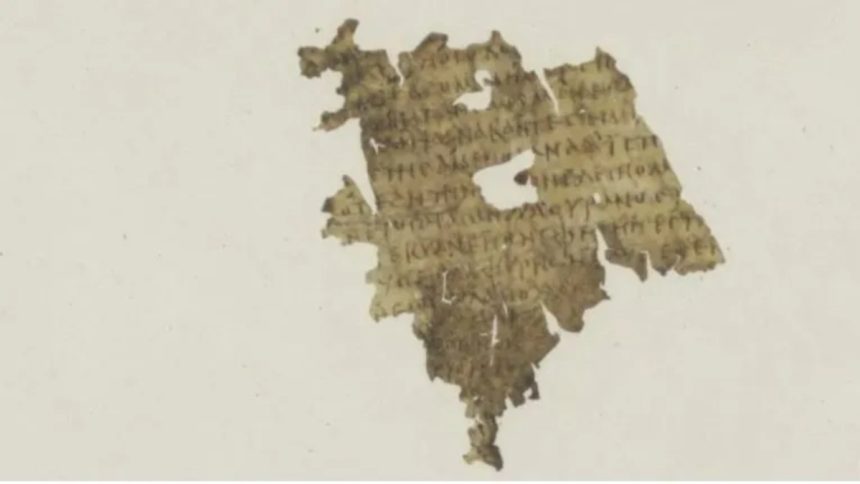
A rare archaeological find has come to light in the Netherlands, as a fragment of Homer’s “Odyssey,” approximately 1,700 years old, was discovered hidden between the pages of a book in the library of Utrecht University .
The fragment dates back to around 300 AD and belongs to an extremely limited group of finds, as only thirty similar examples are known worldwide. The identification was made by Dr. Mark de Kreij , who teaches Greek at Radboud University , while examining a collection of early Christian texts. Until then, the document had been thought to be an Egyptian document from the 7th century , but the researcher recognized almost immediately that it was Homeric verses.
In size, the find does not exceed a playing card and bears writing on both sides . Despite the damage from humidity and discoloration over the centuries, it preserves important evidence of the way ancient Greek texts were circulated and used. Researchers estimate that it was part of an ancient “pocket edition” of the “Odyssey,” which probably belonged to a resident of the Fayum region in Egypt.
The surviving verses come from the twelfth rhapsody , from the episode where Odysseus’ companions, exhausted by hunger, slaughter and eat the sacred oxen of Apollo , violating the explicit prohibition imposed on them.
The position of the verses within the work may partly explain their survival. The twelfth rhapsody is located about halfway through the epic , and ancient books typically wore out from the edges inward, so the deeper a page was, the more likely it was to survive the passage of time.
De Kreij himself did not hide his excitement. Speaking to local media, he described himself as a “treasure hunter,” saying that the ability to locate such rare objects convinces him that he has the best job in the world .