

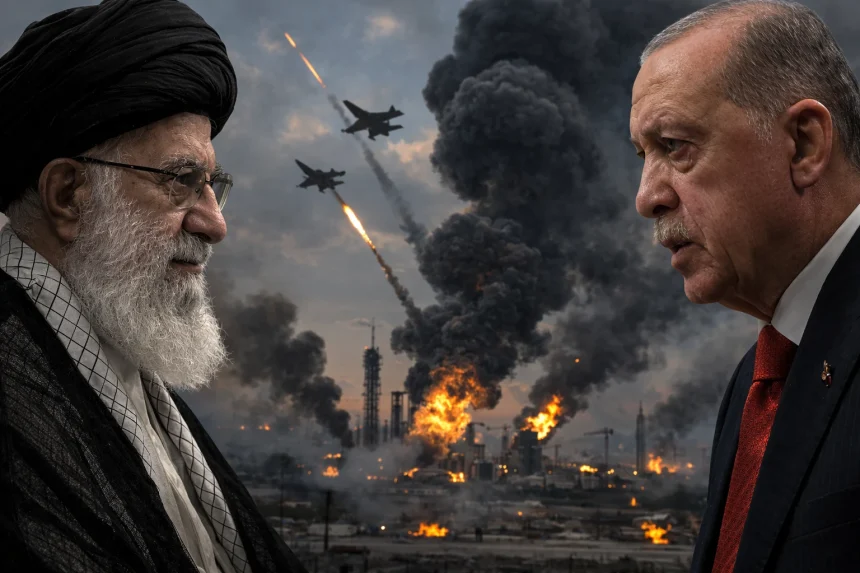
Recep Tayyip Erdogan spoke again in the familiar tone of self-sufficiency and moral superiority. He denounced the attacks by the United States and Israel against the theocratic regime of Iran as a “clear violation” of International Law. He spoke of pain, of a truce, of peace. But behind the words there is no neutrality. There is arrogance . And behind the arrogance, a stable, timeless hostile attitude towards the West .
Erdogan is not simply positioning himself diplomatically. He is attacking politically. He seeks to appear as the authentic spokesman for an Islamic axis that resists the US and Israel. He wants to be recorded in history as the one who “dared” to raise his voice against Washington and Jerusalem. But international politics is not a theatrical stage. It is a field of power.
But the question is simple and relentless: who speaks about International Law? The leader who has militarily invaded neighboring countries? The president who maintains troops on foreign soil? Who openly threatens member states of the European Union? Who instrumentalizes migratory flows? Who has turned the rhetoric about the “Blue Homeland” into a permanent threat against Greek sovereignty?
Hypocrisy has its limits. And here they are being exceeded. Because he made the tragic mistake of turning against Israel and America!
So let’s ask the question clearly: Does he really believe that Donald Trump and Benjamin Netanyahu will let him indefinitely rhetorically attack the West, undermine NATO’s cohesion, and flirt with regimes that are in open conflict with the United States? Does he think he can step on two boats at once, demand American weapons systems, and at the same time adopt rhetoric that is almost hostile toward Washington?
Arrogance has an expiration date.
Erdogan’s Turkey has tried for years to balance itself between the West and a revisionist Middle Eastern bloc. It has flirted with Moscow, kept channels open with Tehran, hosted individuals the West considers a threat. At the same time, it has maintained its role in NATO, seeking to reap the benefits without paying the political cost. But this double game cannot continue indefinitely.
When the US and Israel are in open confrontation with the mullahs of Tehran and attempt to neutralize the influence of organizations like Hamas, Hezbollah and the Houthis, the question is not only what will happen to Iran. The question is who stands against and who stands alongside. And Erdogan, with his rhetoric, chooses to stand against .
It may believe that Turkey’s geographical location offers it immunity. It may believe that no one will risk a rupture with a country that is key to the Black Sea, the Middle East and NATO. But history has shown that when major powers judge that an ally is turning into an unpredictable factor , tolerance runs out.
It’s not just a matter of rhetoric. It’s a matter of strategic trust. And trust erodes when a leader appears to politically legitimize a regime that is in conflict with the US and Israel, while at the same time his country remains institutionally integrated into the Western security architecture.
Erdogan’s arrogance is based on the belief that everyone needs him more than he needs others. But if the Iran issue is closed on terms that strengthen the American-Israeli axis, if terrorist organizations are substantially weakened, then the geopolitical landscape will change. And then Ankara will not be able to pretend to be the “sly neutral” or the self-proclaimed defender of any anti-Western narrative.
So will the Turkish president continue to provoke, considering that tolerance is weakness? Or will he realize that the power of the West is not limited to statements? Because on the global chessboard, rhetoric can win impressions. But power is what ultimately sets the limits.
And the limits, sooner or later, are set.
GEORGE ANTON.