

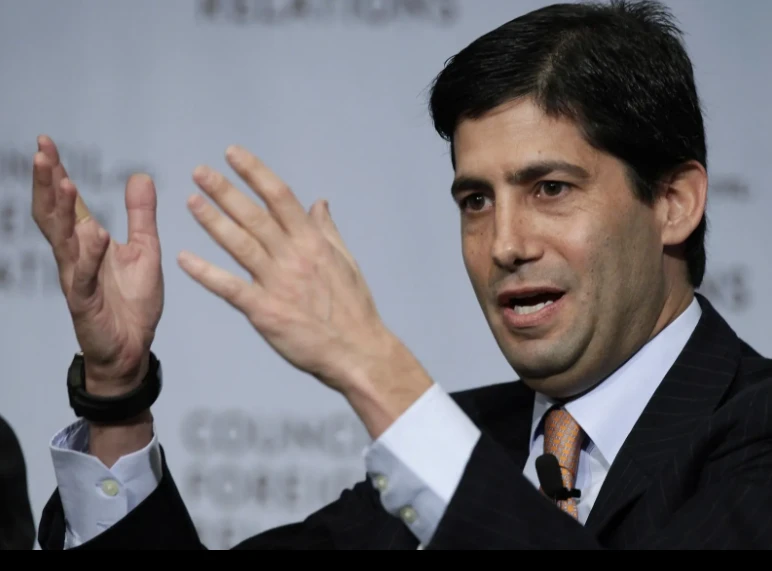
The handover at the top of the Federal Reserve is now official, but it is far from bloodless. Amid a highly charged political climate, the US Senate has ratified President Donald Trump ‘s choice, approving Kevin Ward as the new head.
The vote, which ended 54 votes in favor and 45 against , fully reflects the deep divisions in Washington and is recorded as one of the most polarized central banker confirmation processes in modern American history. Wars is set to take the reins immediately, perhaps within the next week, replacing Jerome Powell , whose term formally expires on Friday, at a time when geopolitical flare-ups, such as the war in Iran, are testing the resilience of the American economy.
However, the real challenge for the new president lies not in the Senate numbers, but in the corridors of the Central Bank itself. Wars comes not as a simple administrator, but as a bringer of sweeping and structural change .
According to the plan he has already presented, he intends to radically reshape the way the Fed communicates with the markets, impose new rules on the management of its monstrous balance sheet and redefine, in uncharted waters, its crucial relationship with the US Treasury Department . His intentions for an extensive restructuring of human resources are already causing strong internal resistance. The climate becomes even heavier if one considers that the outgoing chairman , Jerome Powell, remains a member of the board of directors for an indefinite period. This paradoxical “cohabitation”, after the fierce, public attacks of the Trump administration against Fed officials, threatens to turn monetary policy meetings into a field of internal conflicts.
Wars, now 56, is a familiar face in power circles. Having served as White House economist under George W. Bush and now a visiting fellow at Stanford University’s conservative Hoover Institution, he has had a long history of conflict with the system. In 2006, he made history by becoming the youngest person ever appointed to the Fed’s board of directors at the age of 35. But what has Wall Street analysts deeply troubled is the great economic paradox of his selection.
Donald Trump desperately wants a central banker willing to make deep interest rate cuts to spark growth. But Wars, for most of his career, has been a staunch advocate of tight monetary policy .
It is noteworthy that in 2009, in the midst of the Great Recession and with unemployment soaring, Wars was pushing internally for the rapid withdrawal of support measures , boldly stating that he was much more worried about inflation than about the recession.
Although in recent months, during Trump’s reality search for a candidate, Wars made a spectacular turn to favor easing interest rates , the market has not been fully convinced of this transformation.
This suspicion is summed up perfectly by Anna Wong of Bloomberg Economics , who pointedly emphasized that if the American president was looking for someone “lenient” with inflation, “then he chose the wrong person in Kevin Worth.” It remains to be seen whether the new leader will faithfully serve the White House’s vision or whether his past will awaken at the first resurgence of prices.