

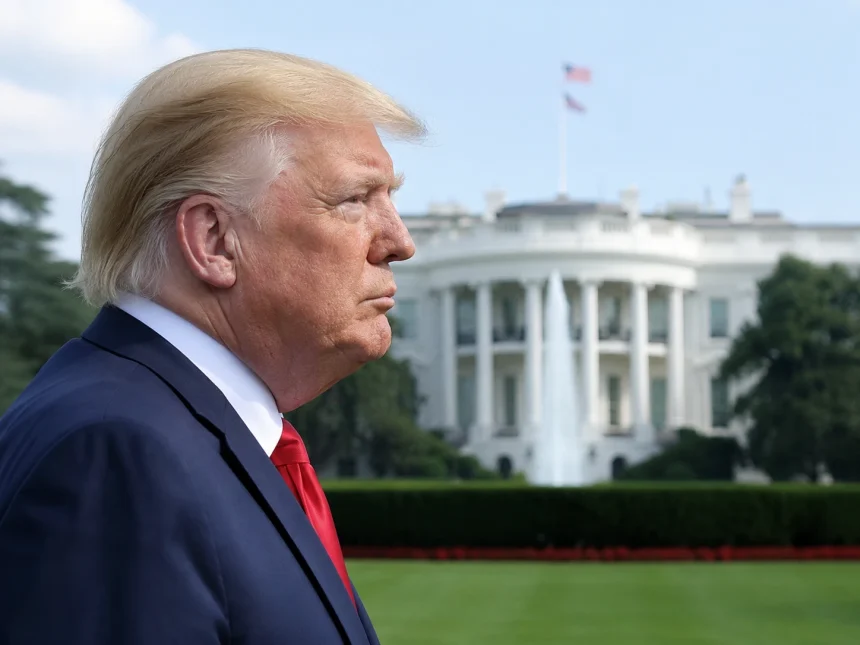
The White House Crisis Management Room hosted one of the most critical meetings of the US-Iran diplomatic chapter today. President Donald Trump had announced a “ final decision ” on the ceasefire extension agreement. The meeting lasted about two hours. However, when it ended, no announcement followed — and that expected “final decision” remained open.
The picture that emerges is that of a process at a critical crossroads : close enough to an agreement to warrant a high-level meeting, far enough away that it cannot yet be signed.
To understand the gravity of the moment, one must go back to the beginning. Trump announced “major military operations” against Iran on February 28, 2026 , with massive joint US-Israeli airstrikes targeting military, government and critical infrastructure. A two-week ceasefire followed, initial talks in Pakistan in April failed, and Trump openly announced an extension of the ceasefire while maintaining the US blockade until the negotiations were concluded. The human and economic cost of this wait is captured in a telling number: since April 13 , when the blockade came into effect, 115 commercial ships have been diverted from their routes, with all the implications for global energy markets and supply chains.
Thursday brought signs of progress. Negotiators from both sides reached a memorandum of understanding that would extend the ceasefire for 60 days and open talks on Iran’s nuclear program . Under the deal, shipping in the Strait of Hormuz would be unhindered, Iran would be required to remove any mines from the strait within 30 days, and the US blockade would be lifted in proportion to the restoration of commercial shipping. However, the agreement is still pending — and therein lies the problem.
Trump chose to publicly announce his “red lines” before the meeting even concluded, posting on social media: full reopening of the Strait of Hormuz without fees, destruction of any mines , a commitment that Iran would never develop a nuclear weapon , and the surrender of its stockpile of enriched uranium to the United States. “No money will be exchanged until further notice. Other issues, of much lesser importance, have been agreed upon,” he wrote. A White House official put it bluntly: “President Trump will only sign a deal if it is good for America and his red lines are met. Iran cannot have nuclear weapons .”
Vice President J.D. Vance said Thursday that while he “cannot guarantee that we will get there” on a deal with Iran, “the president will be in a position to approve the deal, although that remains open.” That phrase aptly sums up the situation: no one is ruling out a deal, no one is guaranteeing it.
Tehran is moving in a different direction. Iranian Foreign Ministry spokesman Esmail Baghaei stated categorically that the country remains focused solely on ending the war and that “there are no negotiations on the nuclear issue .” The Iranian Fars news agency assessed Trump’s statements as “a mixture of truth and lies,” claiming that the memorandum does not include any provision for the destruction of nuclear material . The contradiction is deafening: the two sides appear to be negotiating on different subjects.
The head of the Iranian negotiating team, Parliament Speaker Mohammad Bayer Qalibaf , set the same tone with relentless clarity: “No action will be taken before the other side acts. The winner of any agreement is the one who is best prepared for war the next day.” In the context of peace negotiations, this language leaves little room for optimism.
The ceasefire, moreover, seems to be holding with difficulty. as both the US and Iran accuse each other of violations . On Thursday, the Revolutionary Guards announced that they had struck a US air base in Kuwait , which they described as the starting point of previous attacks on the strategic port city of Bandar Abbas , near the Strait of Hormuz. The US Central Command (CENTCOM) described the strike as a “ flagrant violation of the ceasefire ” and stressed that the situation remains extremely fragile .
This fragile balance is also reflected at the level of sanctions: the US government today imposed new sanctions on an Iranian organization that controls the Straits, a move that can be interpreted either as negotiating pressure or as a sign that Washington’s endurance is running out.
The crux of the disagreement remains the nuclear issue itself. Washington insists that any permanent solution must include nullifying Iran’s nuclear capability , something Tehran sees as an existential issue of national sovereignty. There is no easy compromise between these two positions. And as the days pass, the 115 commercial ships that remain anchored in the region are a reminder that the economic clock is ticking in parallel with the diplomatic one.