

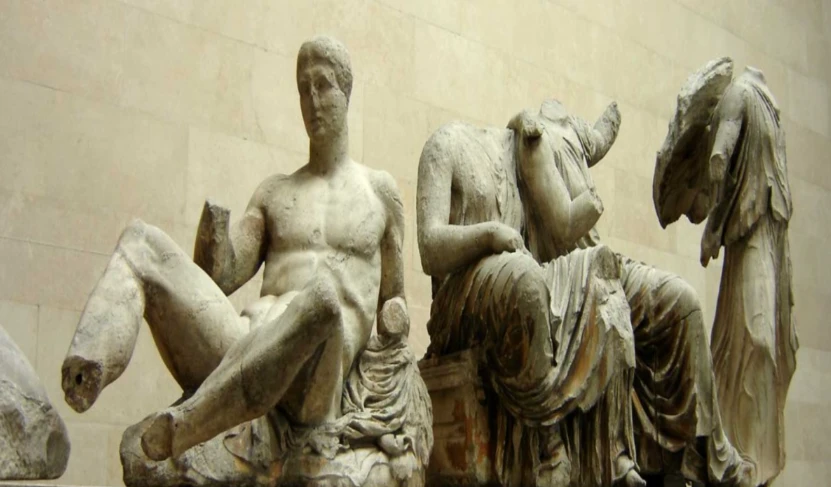
The conclusion of the 25th Session of UNESCO’s Intergovernmental Committee for the Return of Cultural Property to its Countries of Origin marks a historic turning point in the long-running struggle to reunite the Parthenon Sculptures . This year’s session, however, was not just another formal exchange of arguments, but a strategic Waterloo for London.
The most decisive and impressive development of the conference was the fact that Turkey completely and officially “emptied” Britain , dealing a final blow to the most central and most debated argument that the British Museum has been using for two centuries: the alleged existence of a government document, the famous Sultan’s Firman , which supposedly legitimized Lord Elgin’s plunder.
The intervention of the Turkish delegation, which participated as an observer state, was catalytic and deprives the United Kingdom of any trace of historical and legal justification. Ankara, as the direct historical successor of the Ottoman Empire, clarified in the most categorical manner that there is no sultanic document or firman in the archives that would approve or legalize the forcible removal of the Sculptures from the Acropolis monument.
The Turkish side did not limit itself to debunking the myth, but proceeded with an unprecedented diplomatic recommendation, calling on the United Kingdom to immediately stop using the firman claim in all international fora. This official admission by the very country that supposedly issued the document completely dismantles the British narrative of “legal acquisition” and irreparably exposes the British Museum’s management to the international community.
This historical “emptying” came to fit in perfectly with the extremely thorough presentation of the Greek delegation, which highlighted the depth of British culpability. The Greek side focused not only on the illegal appropriation of the masterpieces of Phidias , but also on the irreparable damage caused by their violent detachment, as well as on the subsequent failed cleaning operations in the London halls. In addition, Athens brought to light an extremely revealing move by the British government, which recently attempted, bypassing Parliament itself , to exempt the British Museum from the Charities Act 2022 . This tactic was done in order to prevent the museum from returning exhibits for ethical reasons , demonstrating the panic of the British side and its insistence on offering the unacceptable “loan” as the only option.
The combined pressure of Greek argumentation and Turkish gagging led the United Kingdom to a state of absolute diplomatic isolation . Despite the British’s standard, stereotypical response that the Sculptures are accessible to millions of visitors and that the domestic legislative framework prohibits their return, the vast majority of UNESCO member states and observers openly sided with Greece. Countries with a huge cultural diaspora, such as Italy, China, Brazil and Egypt , strongly supported the just demand for reunification at the Acropolis Museum , creating a formidable global front.
The result of this strategic dominance was clearly reflected in the final text of the Recommendation adopted by the Intergovernmental Committee. For the first time in history, the international organization explicitly recognizes that the Parthenon Sculptures constitute an integral part of the Greek cultural heritage and identity , transforming the issue from a simple legal difference between two museums into a fundamental moral and cultural obligation.
UNESCO expressed its deep concern about the long-standing impasse , called on both sides to intensify their efforts based on the moral dimensions of the issue, and mobilized its own director-general to facilitate the talks.
With the pseudo-argument of the firman now crushed to powder by Turkey itself, Greece comes to the next, 26th, Summit, having in its hands an invaluable diplomatic weapon that definitively changes the terms of the game.